How to Measure and Weigh a Parcel: Volumetric Weight
Couriers bill your parcel on whichever is greater, what it weighs on the scale or its volumetric weight. Volumetric weight is length × width × height in centimetres divided by 5000 for most Ecoparcel courier services. A 40 × 30 × 20 cm box comes out at 4.8 kg of volumetric weight, so a 3 kg box of pillows that size is billed as 4.8 kg. Measure the packed parcel at its longest points, handles, straps, bulges and tape included, and weigh it with the packaging on. The volumetric weight calculator does the arithmetic if you would rather not. Under-declaring saves nothing: every parcel is re-weighed inside the carrier network, and the difference is billed back after delivery.
Key takeaways
- Volumetric weight = L × W × H in cm ÷ 5000. Some services use a different divisor, so the live quote is the authority.
- You pay the higher of actual and volumetric weight. Ecoparcel order data for August 2025 to July 2026 shows volumetric weight was the higher figure on 40.0% of orders.
- Girth = L + 2 × (W + H). Long parcels hit a girth cap before they hit a weight cap.
- Carriers re-weigh parcels. Differences beyond 1 kg per parcel are billed after delivery, and you can dispute a charge with photo evidence.
- Work it out in seconds with the volumetric weight calculator.
How is volumetric weight calculated?
Volumetric weight is a billing weight couriers derive from a parcel's volume: length × width × height in centimetres divided by a courier divisor, 5000 for most Ecoparcel services, so that large, light parcels pay for the van space they occupy rather than for their mass.
Take the three outside dimensions of the packed box in centimetres, multiply them, divide by 5000:
40 × 30 × 20 cm = 24,000 cm³ ÷ 5000 = 4.8 kg volumetric weight.
Divisors are set per courier in our system, and a few services use 6000 instead of 5000, which produces a lower volumetric weight for the same box. The price you see when you book already has the right divisor applied, so treat the quote as the authority and the formula as the sanity check.
| Parcel | Dimensions | Volumetric weight (÷ 5000) | Actual weight | Billed as |
|---|---|---|---|---|
| Duvet and pillows | 60 × 40 × 40 cm | 19.2 kg | 3 kg | 19.2 kg (volumetric) |
| Box of books | 30 × 25 × 20 cm | 3.0 kg | 12 kg | 12 kg (actual) |
| Pair of boots | 40 × 30 × 20 cm | 4.8 kg | 2.5 kg | 4.8 kg (volumetric) |
| Hand tools | 40 × 30 × 20 cm | 4.8 kg | 15 kg | 15 kg (actual) |
| Floor lamp | 80 × 40 × 40 cm | 25.6 kg | 6 kg | 25.6 kg (volumetric) |
Two parcels of identical size are billed differently depending on what is inside them. The lamp and the boots both lose to their volumetric weight; the books and the tools are dense enough that the scale wins.
What is billable weight?
Billable weight, also called chargeable weight, is the weight you actually pay for: the greater of the parcel's actual weight on the scale and its volumetric weight. Our pricing engine takes the maximum of actual and volumetric weight for every parcel, so there is no averaging and no rounding in your favour.
According to Ecoparcel order data, volumetric weight came out above actual weight on 40.0% of orders shipped between August 2025 and July 2026. Two parcels in five are priced by their size, not their mass.
If the parcel is an odd shape, measure it as though it were inside the smallest box it would fit into. A bicycle wheel, a rolled carpet or a car bumper all get boxed dimensions, not their own outline. Bags and suitcases include straps and handles in the measurement, and both need reboxing before they travel anyway, which the restricted items list sets out.
How do I weigh my parcel at home?
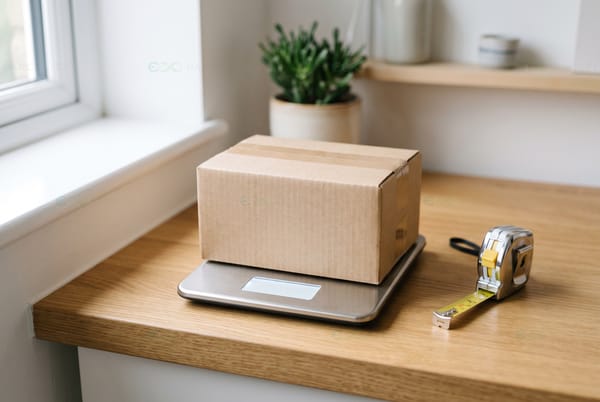
Weigh the parcel after it is packed and sealed, not the item on its own. Boxes, tape, bubble wrap and void fill all count.
- Large or heavy boxes: stand on your bathroom scales holding the parcel, then weigh yourself alone and subtract. Bathroom scales are accurate enough for parcels above a few kilos.
- Small parcels: use kitchen scales and place the parcel centrally on the platform.
- No scales at home: original packaging often prints the item weight, and online retailer listings usually publish it in the product specifications. Add roughly 300 to 800 g for a small to medium box with cushioning, then round up.
Rounding up costs you almost nothing on the quote. Rounding down invites a surcharge later.
Median declared weight across our platform is 6.00 kg per parcel, and 49.5% of parcels are 5 kg or under, so most senders are working with kitchen-scale quantities rather than freight.
How do I measure a parcel?
Use a tape measure on the finished parcel and record the longest point of each side. Bulges, tape ridges, protruding handles and straps are part of the measurement.
Girth is a size measure couriers use for length limits: the parcel's longest side plus twice the sum of its width and height, written as L + 2 × (W + H). The 40 × 30 × 20 cm box above has a girth of 40 + 2 × (30 + 20) = 140 cm. Long, narrow parcels such as skis, fishing rods or curtain poles usually run out of girth allowance long before they run out of weight allowance, which is why a 4 kg parcel can be refused while a 25 kg one goes through.
If you have no tape measure, iPhone owners can use Apple's built-in Measure app. There is no equivalent shipping with Android: Google ended support for its AR Measure app and pulled the Play Store listing on 8 June 2021, so the advice to install it, which this guide used to give, no longer works. A €3 tape measure is more accurate than any camera anyway.
What happens if I declare the wrong weight or size?
Parcels are weighed and scanned inside the carrier network, twice over. Approximate weights arrive from tracking events while the parcel is moving; final weights come from the carrier's own invoice after delivery. Both are recorded against your order.
A weight surcharge is the extra charge applied when a carrier's re-weigh shows the parcel exceeded the declared weight by more than the allowed tolerance. Ours works like this:
- 1 kg of tolerance per parcel. A ten-parcel order absorbs 10 kg before anything is charged.
- Amounts of €0.50 or less are never charged. Rounding differences are written off, not billed.
- You are emailed when a surcharge is applied, with the declared weight, the carrier's weight and the amount.
- You can dispute it from Manage Order, uploading photos and notes. Valid disputes are reverted and the money goes back to your balance.
The numbers are not dramatic and they are not trivial either. Of the orders that received a final carrier weight between August 2025 and July 2026, 4.9% were surcharged. On those orders the declared weight averaged 20.28 kg against a carrier weight of 30.94 kg, leaving 9.15 kg of billable excess and an average charge of €9.89, median €6.56. Of those charges, 1.3% were disputed and reverted.
This is exactly why the old advice in this guide still holds: film the packed parcel on the scale, showing the reading, then run the tape measure along each side on camera. Thirty seconds of video settles a dispute that email cannot.
Re-weigh events appear against your shipment, so you can track your parcel and see the scan history yourself.
What are the maximum weight and size limits per courier?
Limits are set per route, not per courier. The same carrier will take 30 kg on one lane and 20 kg on another, and locker services always cap smaller than door-to-door because the locker compartment sets the ceiling. The quote you get for your specific origin and destination is the only authoritative answer.
Two rules of thumb that do hold across our network: parcel services stop at the point where a single person can no longer lift the item safely, and anything above that ships as a pallet instead. If your load is heavy, bulky or several boxes at once, compare the parcel and pallet options side by side in parcel and pallet services.
Frequently asked questions
How do couriers calculate volumetric weight?
Multiply the parcel's length, width and height in centimetres and divide by the courier's divisor, which is 5000 for most Ecoparcel services. A 40 × 30 × 20 cm box gives 24,000 cm³ ÷ 5000 = 4.8 kg. The volumetric weight calculator does it for you.
What happens if my parcel weighs more than I declared?
Carriers re-weigh parcels in transit and invoice us on the real weight. Differences above 1 kg per parcel are charged back to your account after delivery, with an email showing the declared and audited weights. Amounts of €0.50 or less are never charged, and you can dispute a surcharge with photos.
Do I include the box and packaging in the parcel weight?
Yes. Weigh the parcel exactly as the courier will receive it, sealed, labelled and with all cushioning inside. Cardboard, tape, bubble wrap and void fill add several hundred grams to a medium box, and leaving them out is the most common reason a declared weight comes up short.
How do I measure an irregularly shaped parcel?
Measure it as if it were inside the smallest box it would fit into, and use those three dimensions. Include anything that sticks out: handles, straps, wheels, protruding corners. Couriers measure the space a parcel occupies on the belt and in the van, not its silhouette.
Is volumetric weight ignored when it is lower than actual weight?
Yes. You are billed on the higher of the two figures, so a dense parcel is priced on the scale reading and its volumetric weight has no effect. Volumetric weight only changes the price when the parcel is bulkier than it is heavy, which happens on 40.0% of our orders.
Measure once, book once
Weigh the sealed parcel, measure it at its longest points, take the higher of actual and volumetric weight, and the price you are quoted is the price you pay. Pack it first if you have not already, following the packaging guidelines, because the finished box is what gets measured.