Parcel Packaging: How to Pack a Parcel Safely
Pack your parcel in a new corrugated cardboard box sized to the item plus 2 to 5 cm of cushioning on every side, wrap the contents individually, fill every void so nothing shifts, seal it with the H-tape method, and stick the label flat on the largest face. Use double-wall board for anything heavy, fragile or travelling a long way. Check the restricted items list before you book, because items on it travel without any compensation for loss or damage, and some are refused outright. Suitcases and soft bags are not outer packaging: a suitcase you are shipping has to be wrapped and put inside a box of its own.
Parcel packing best practices
| Do this | Why |
|---|---|
| Use a new, strong corrugated box | Used board has lost stiffness and collapses under stacking |
| Prefer double-wall for heavy or fragile goods | Two fluted layers resist crushing and puncture |
| Fill every void | Nothing should move when you shake the box |
| Seal with the H-tape method | Keeps every flap closed under load |
| Keep plastic wrap off the outside | Torn film hides labels and barcodes |
| Size the box to the item | An oversized box costs more, because you pay volumetric weight |
| Check the restricted items list | Restricted goods ship with no compensation |
| Load pallets with the weight low and inside the edges | Prevents overhang damage and toppling |
What box should I use to ship a parcel?
A new, undamaged corrugated cardboard box designed for shipping. Storage boxes, gift boxes and reused supermarket cartons have already lost their stiffness and fail under the weight of whatever is stacked on them in the van.
A double-wall box is a corrugated cardboard box with two fluted layers between three liners, which gives it far higher stacking and puncture resistance than single-wall board. It is the standard choice for heavy, fragile or long-distance shipments. Single-wall is fine for light, hard-wearing goods over short distances.
Size it to the item plus 2 to 5 cm of cushioning on every side. Bigger is not safer. An oversized box gives the contents room to build momentum, and it costs you money: volumetric weight is a billing weight calculated from a parcel's dimensions rather than its mass, and couriers charge whichever is greater, the actual or the volumetric weight. On 40.0% of the orders we shipped between August 2025 and July 2026, the volumetric weight was the higher of the two. The volumetric weight calculator shows you what a box size costs before you buy it.
The EU is moving the same way: Regulation (EU) 2025/40 on packaging and packaging waste (PPWR), in force since 11 February 2025 and applying from 12 August 2026, caps the empty space in grouped, transport and e-commerce packaging at 50%, from 1 January 2030 at the earliest.
Soft containers are not outer packaging. Bags, duffel bags and suitcases get crushed, torn and deformed on a sorting belt, and our restricted items list treats them as such: soft travel bags, backpacks and duffel bags must go inside a cardboard box, and a suitcase is not accepted unless it has been reboxed. If the suitcase itself is what you are sending, wrap it in bubble wrap and place it inside a double-layered box. The suitcase packing guide walks through it.
How do I pack a parcel so nothing breaks?
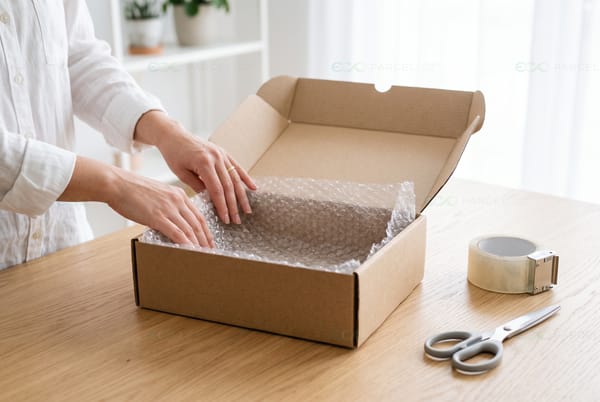
- Wrap each item individually in bubble wrap or foam. Two unwrapped items in one box will find each other.
- Separate multiple items with cardboard dividers or padding so they cannot touch.
- Fill every void with air pillows, crumpled kraft paper, packing peanuts or foam inserts. Void fill is cushioning material that occupies the empty space inside a parcel so the contents cannot shift during automated sorting and transit.
- Do not overstuff. A bulging box will not stack, and the seams split.
- Shake it. Nothing should move inside the box. If something does, open it and add more fill.
Keep 5 cm of cushioning between a fragile item and any wall of the box, and never let it rest against a corner.
How should I seal and label a parcel?
H-taping is a box-sealing method where tape runs along the centre seam and both edge seams, on the top and the bottom of the box, forming an "H" that keeps every flap closed under load. Use strong PVC or polypropylene packing tape, not masking tape or household sticky tape.
- Attach the label flat on one full side, away from seams, corners and edges.
- Keep barcodes and QR codes unobstructed. A tape strip across a barcode stops the parcel at the first scanner.
- Do not wrap the outside in cling film or plastic. If you need moisture protection, put the film under the label or use a document wallet over the top, so the label stays fully readable.
- Remove old labels from reused boxes. Two barcodes on one parcel sends it to two places.
- International parcels carry customs documents as well; the customs declarations guide covers what goes on them.
Does a "Fragile" sticker get special handling?
No. All parcels are handled on conveyor belts, and no special treatment is given to those marked "Fragile". The sticker changes nothing about how the parcel is sorted.
What does help is packing for a machine rather than for a careful person: double-wall board, individual wrapping, 5 cm of cushioning on every face, and no void anywhere inside. Assume the box will be dropped from belt height onto another box, because at some point it will be.
For valuable contents, add Additional Parcel Protection at checkout. It covers the declared value of the parcel up to €1,000 per parcel, on top of the carrier's base cover. Glass and ceramics sit on the Not Recommended side of our restricted items list either way, and the fragile items guide has the detail.
How should I pack it, by item type?
| Item type | Box spec | Cushioning | Extra step | Related guide |
|---|---|---|---|---|
| Books, clothes, toys | Single-wall, snug fit | Crumpled paper | Best for dense, hard-wearing goods | Weighing and measuring |
| Electronics with the battery installed | Double-wall | Foam on all faces | Loose lithium batteries and power banks are prohibited | Restricted items |
| Glass and ceramics (not recommended) | Double-wall | Bubble wrap each item, dividers, 5 cm walls | No compensation if it breaks | Packing fragile items |
| Liquids up to 1 litre (not recommended) | Double-wall | Absorbent material around a sealed, leak-proof container | Over 1 litre is not recommended at all | Restricted items |
| Suitcase or soft bag as the item | Must be reboxed, double-layer box | Bubble wrap around the case | Never use it as the outer packaging | Packing a suitcase |
| Several heavy boxes at once | Ship as a pallet | Stretch wrap and straps, heavy items at the bottom, no overhang | Compare parcel and pallet prices | Pallet packing |
"Not recommended" is the wording from our restricted items list, and it means what it says: you can send these, and no compensation is paid if they are lost or damaged.
What happens if my parcel is badly packed or overweight?
Three things, in rising order of annoyance.
The driver refuses collection. A parcel that is visibly damaged, leaking, bulging or packed in a bag does not get on the van. Anything wet, leaking or giving off an odour is prohibited outright and may be disposed of for hygiene and safety reasons.
A claim is refused. Items on the restricted list travel without compensation for loss or damage, whatever the packing. That is the trade you make by sending them.
The weight is re-billed. Every parcel is weighed inside the carrier network, and the carrier invoices us on the weight it measured. Differences above 1 kg per parcel are charged back to your account after delivery. Between August 2025 and July 2026, about 4.9% of the orders that received a final carrier weight were surcharged, averaging €9.89. Weigh and measure the finished parcel, not the item; the weighing and measuring guide explains how, and why filming the box on the scale is worth thirty seconds.
The good news is that damage is rare when the box is right. Damage claims ran at roughly 0.25% of shipments in that same year, about one order in 400.
How do I pack goods on a pallet?
- Use a strong, undamaged wooden or plastic pallet.
- Stack boxes evenly, heaviest on the bottom, lightest on top.
- Keep everything inside the pallet edges. Overhang is the single most common cause of pallet damage, because anything sticking out is what the forklift and the neighbouring pallet hit first.
- Secure the load with stretch wrap and straps, wrapping down onto the pallet itself.
- Check the load is balanced and will not tip when the pallet is lifted from any side.
The pallet packing guide covers wrapping patterns, corner protection and labelling in detail.
Which items can't I ship even when well packed?
The canonical restricted items list is the authority and it is kept up to date. These are the categories that trip people up most often on packaging grounds:
| Item | Status | Packaging note |
|---|---|---|
| Aerosols, flammable liquids, compressed gases | Prohibited | Dangerous goods. No packaging makes them acceptable |
| Loose lithium batteries and power banks | Prohibited | Batteries installed in a device are Not Recommended but allowed |
| Alcoholic beverages | Prohibited | All of them, however well packed |
| Suitcases and soft bags | Prohibited unless reboxed | Bubble wrap the case, then a double-layer box |
| Anything wet, leaking or giving off an odour | Prohibited | May be disposed of for hygiene and safety reasons |
| Glass, ceramics, fragile goods | Not recommended | Ship at your own risk, no compensation |
| Liquids over 1 litre | Not recommended | Under 1 litre: sealed, leak-proof, absorbent packed |
Shipping a restricted item means no compensation for loss or damage, and customs or the carrier may dispose of the parcel. Check the full list before you book rather than after.
Pre-dispatch checklist
- Shake the box. Nothing moves.
- Press the seams and corners. Nothing gives.
- Label flat, fully readable, barcode clear, old labels removed.
- Weigh and measure the sealed parcel, packaging included.
- Confirm nothing inside is on the restricted list.
- Photograph the packed parcel and its contents before sealing, for insurance and customs.
Frequently asked questions
Does Ecoparcel or the courier pack my parcel for me?
No. You pack and seal the parcel before collection, and it must be in a cardboard box. The driver collects a finished, labelled parcel and will refuse one that is loose, in a bag, or visibly damaged. Follow the box and cushioning steps above before you book the pickup.
Can the courier bring a box, or do you sell packaging?
No. We do not supply boxes, tape or cushioning, and drivers do not carry packaging materials. Buy a new double-wall corrugated box in the size you need before your collection date. Stationery shops, hardware stores and online packaging suppliers all stock them.
Can I ship a suitcase or travel bag as it is?
No. Suitcases are not accepted unless reboxed, and soft travel bags, backpacks and duffel bags must be placed inside a cardboard box. Wrap the case in bubble wrap and put it in a double-layered box. Soft luggage used as outer packaging gets crushed or torn on the sorting belt.
What do I do if my parcel arrives damaged?
Photograph the outer packaging, the damaged item and the label before you throw anything away, then open a claim through our help centre. Keep the packaging until the claim is settled. Items on the restricted list are not covered, whatever the packaging.
Can I ship alcohol or wine?
No. All alcoholic beverages are prohibited on our services, including wine, beer and spirits, and no packaging makes them acceptable. A parcel found to contain alcohol may be held or disposed of by the carrier, and no compensation is paid.
Will a "Fragile" label make couriers handle my box gently?
No. Parcels move on conveyor belts and marked boxes get no special treatment. Pack for machine sorting instead: double-wall board, each item wrapped, 5 cm of cushioning on every face and no empty space. Add Additional Parcel Protection at checkout for valuable contents.
Ready to send it
A parcel that passes the shake test, holds its shape at the seams and carries one clean label is a parcel that arrives in the same condition it left. Weigh and measure the finished box, check the restricted list, and book.